

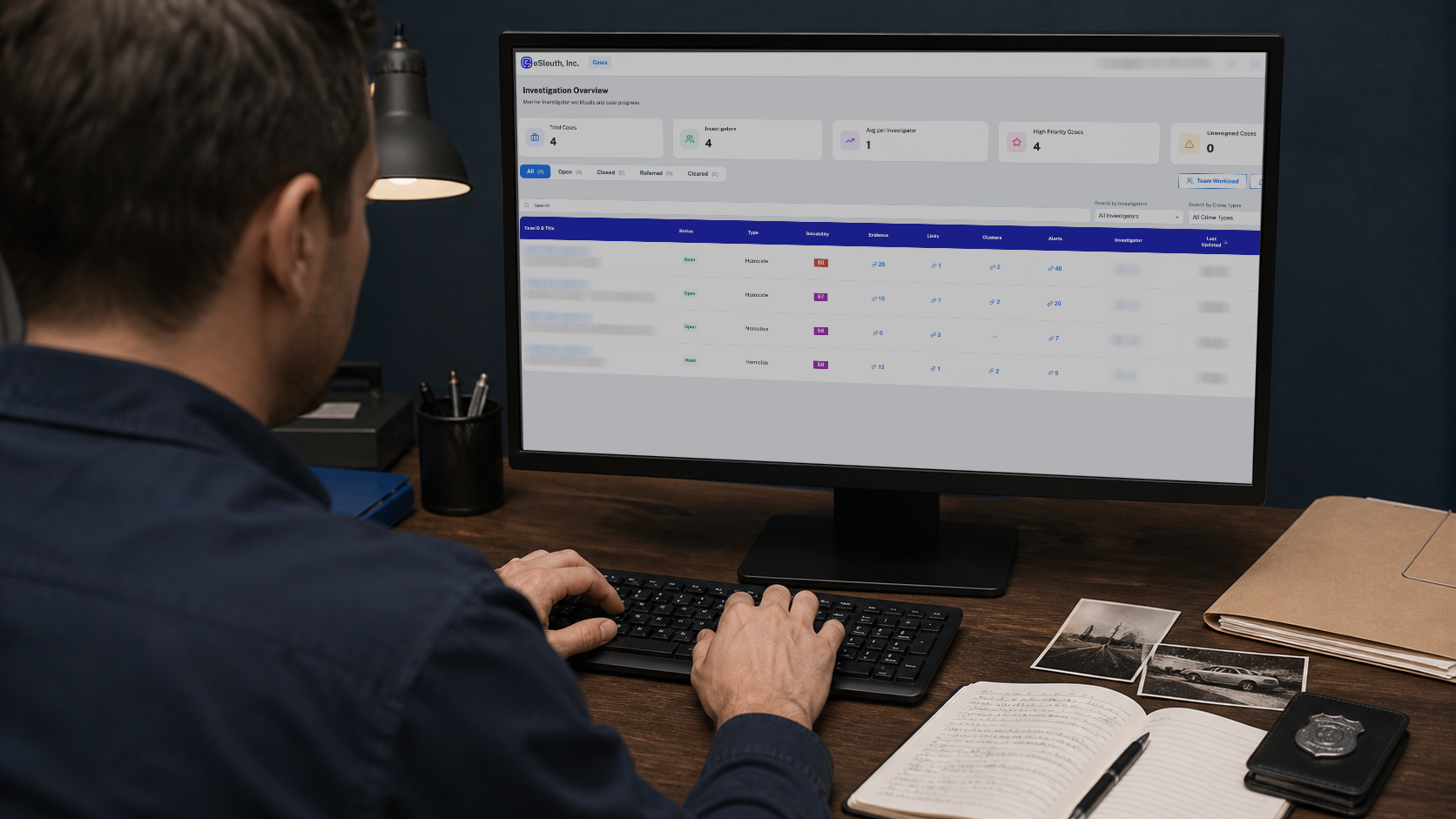
eSleuth AI CEO Robert Batty responds to public concerns about AI in policing, raised by ASU researchers Michael Scott and Gail-Joon Ahn. He walks through how eSleuth AI keeps investigators in control: a closed platform that only touches an agency's own data, CJIS-compliant security, a full chain-of-custody audit trail, and outputs that stay leads until a human verifies them. Never final conclusion
Concerns about artificial intelligence in policing should be taken seriously. Public trust matters. Accuracy matters. Privacy and data security matter. When respected voices such as Michael Scott, director of Arizona State University’s Center for Problem-Oriented Policing, and Gail-Joon Ahn, director of the Laboratory of Security Engineering for Future Computing at ASU, raise questions about the use of AI in law enforcement, the right response is not to dismiss those concerns. The right response is to explain, clearly and confidently, what responsible AI in policing should look like.
That is exactly why we built eSleuthAI the way we did.
First and foremost, eSleuth AI is not a decision-maker. It does not arrest anyone. It does not charge anyone. It does not prosecute anyone. It does not decide guilt or innocence. Those responsibilities belong where they have always belonged: with trained investigators, prosecutors, judges, juries, and the safeguards of due process.
eSleuth AI is an evidence-based investigative tool. It helps law enforcement professionals analyze information that already exists within their agency-controlled data sources. It is designed to help investigators identify leads, patterns, connections, and relevant facts more efficiently. It supports police work; it does not replace police judgment.
That distinction matters because most public concern about AI involves broad, internet-connected, general-purpose systems. eSleuth AI is a closed platform. It does not access the internet. It analyzes evidence and records from the agency’s own data sources, inside a controlled environment — fundamentally different from a tool that pulls from unverified public material.
Michael Scott is right to warn that mistakes in policing can carry serious consequences. No responsible technology company should pretend otherwise. But the answer isn’t to deny investigators better tools. The answer is to build tools that keep humans in control, require verification, and improve the ability of investigators to review large volumes of evidence carefully and consistently.
eSleuth AI outputs should be treated as investigative leads, not final conclusions. Every lead must be reviewed and validated through normal investigative procedures. Used properly, an evidence-based AI tool can help investigators find what might otherwise be missed, organize complex case information, and spend more time applying human judgment where it matters most.
Gail-Joon Ahn is also right to focus on data security. Sensitive criminal justice information must be protected with rigor. That is why eSleuth AI adheres to CJIS security requirements. Security is not an add-on to our platform. It is a core design requirement.
Responsible AI in policing requires controlled access, authentication, auditability, and clear agency policy. That is what our chain-of-custody audit trail is built for: agencies should know who accessed sensitive information, when, and for what purpose. Technology should strengthen that accountability, not obscure it.
We also believe AI in policing should be guided by national best practices, not hype. eSleuth AI is built to align with the guidelines recommended for AI use in policing by the International Association of Chiefs of Police AI Committee, on which I serve as an inaugural member.
The future of policing should not be a choice between innovation and accountability. Law enforcement agencies deserve modern tools that help them solve crimes, protect victims, and use limited resources wisely. Communities deserve assurance that those tools are secure, evidence-based, auditable, and governed by human judgment.
Walk into the budget meeting with the numbers already run.
Enter your investigator count, fully burdened cost, and the hours your team loses to manual review. You'll see what that time is worth — grounded in data from agencies already running eSleuth AI.
See how eSleuth helps agencies solve more cases with the resources they already have.
Request a Live Demo